
From Chicago to LA, Neighborly Solidarity Fuels Resistance to ICE

This article was first published by the nonprofit newsroom LA Public Press on November 5, 2025 and is republished here with permission.
When ICE comes to their neighborhoods, residents in Los Angeles and Chicago know it’s time to act. On an almost daily basis for months, federal agents, often heavily-armed and masked, have descended on their cities, deploying tear gas at people outside a Home Depot, beating protesters and journalists, or snatching beloved tamale vendors. The community response has been loud and vigilant.
Neighbors are protecting those around them, providing food, recording potential constitutional violations and sharing resistance strategies for others to replicate.
“It has to be an entire village to take [ICE] on, and LA is a massive village,” said Matthew Hunter, a longtime LA activist who has participated in rapid response efforts since June when ICE escalated immigration enforcement in the region. “But we need to build permanent structures of struggle to outlast this.”
There is no reason to believe the Trump administration will slow down its escalating immigration enforcement operations in Democrat-led cities — aimed at deporting the “worst” criminals, but in reality, mostly sweeping up people who have no criminal convictions.
But with Immigration and Customs Enforcement (ICE) set to receive a $75 billion budget increase, LA and Chicago are offering a blueprint to residents of other cities for the fight to come. In recent weeks, Block Club Chicago and LA Public Press interviewed people in both cities to understand how activists are defying ICE, learning from each other, documenting agents’ actions and supporting people impacted by arrests.
Los Angeles: A testing ground for ICE and mass resistance
People across LA County are doing more than protesting and bearing witness to injustice. They’re joining “rapid response networks” that use encrypted chats to track the Department of Homeland Security’s (DHS) movements, alert communities about immigration enforcement and coordinate mutual aid for people impacted by arrests.
Every morning, hundreds, if not thousands, of people mobilize through these networks to counter ICE, Hunter said. They track agents’ movements, drive around their neighborhoods checking for ICE and set up know-your-rights booths outside Home Depots to support day laborers. He said he’s never seen grassroots mobilization in LA at this scale.
“’There’s not a day that goes by where you don’t feel that human suffering in our communities, and at the same time, I’ve seen communities organize here in ways that I haven’t seen in all my years of organizing,” Hunter said. “We’re talking about thousands of people that have been activated.”
Not everyone in rapid response networks knows each other, but people are compelled to act given what is happening to their loved ones and neighbors, Hunter said.
“It feels closer to home. This is a military takeover and invasion of our communities,” Hunter said. “It’s mind blowing to see the community response and the desire to want to protect our neighbors, our friends and loved ones.”
DHS Assistant Secretary Tricia McLaughlin said in a statement to LA Public Press the agency has made 7,800 arrests in LA County since June 6. “Illegal aliens have a choice: they can either leave now voluntarily and receive a $1,000 [payment] or they can [be] arrested, detained, and removed without the ability to return the right legal way.”
Miriam Arghandiwal, an LA labor activist and member of the Boycott Home Depot Coalition, told LA Public Press that current activism has roots in prior campaigns against LA Police Department violence, anti-Black racism and anti-immigrant policies such as the heavily-opposed Prop. 187.
“We’ve always been a testing ground, but there’s always been a level of resistance here too,” Arghandiwa said. She said anti-ICE actions in LA demonstrate a capacity to deeply support immigrant communities in ways that elected officials have failed to do. “It speaks to the strength of our solidarity,” she added.
Looking to Chicago, Arghandiwal said she’d like to see her elected officials on the front lines confronting ICE, as one Chicago alderwoman did last week, and passing legislation that defends immigrants in concrete ways instead of sharing “performative” statements of solidarity.
Elected officials in LA could replicate Chicago Mayor Brandon Johnson’s policy barring ICE from public property, including school campuses and city-owned parking lots, she said.
Having multiple cities experimenting with anti-ICE resistance could benefit communities around the country, Hunter said.
“I’m seeing what’s happening in Chicago every day. It’s a direct echo to what we experienced,” Hunter said. “LA has been very open about our tactics because they’re absolutely legal, and we want other [cities] to know about them.”

Chicagoans resist ICE with whistles in hand
Since the start of “Operations Midway Blitz” and “Operation At Large” in September in Chicago, federal agents have shot at least two people, killing one; repeatedly tear-gassed protesters andfirst responders; shot rubber bullets at protesters; detained U.S. citizens, including children; handcuffed a Chicago alderperson in a hospital; smoke-bombed and tear-gassed a Chicago street; fired a chemical weapon at a TV reporter and detained a journalist, among other incidents.
In Chicago, whistles have become a popular tool to alert neighbors of federal agents. They’re faster than text messages or social media posts.

In Little Village, home to one of the largest Mexican-American communities in the Midwest, neighbors began using whistles to alert neighbors of immigration agents in early September, after hearing from LA residents who had used whistles.
Volunteers across the city have printed thousands of copies of a zine created by the Pilsen Arts & Community House. The zine explains how to use the whistles: Blow in short bursts if you see an agent, and blow in a long, continuous pattern if they’re detaining someone.
In mid-October, hundreds of volunteers gathered in Northwest Side restaurants to assemble whistle kits, which were then distributed for free in their communities. The initiative was led by Belmont Cragin United, a neighborhood group serving one of the largest Latino communities in Chicago.
The kits include a zine, “know your rights” explainers from the American Civil Liberties Union and cards to hand to immigration agents if detained.
Whistlemania, as the group named the whistle-kit assembling events, started when Alonso Zaragoza, one of the lead organizers of Belmont Cragin United and a group of neighbors posted an invitation on social media for others to gather at a restaurant to build kits.
Zaragoza expected 15 or 20 neighbors. About 400 came, he said.
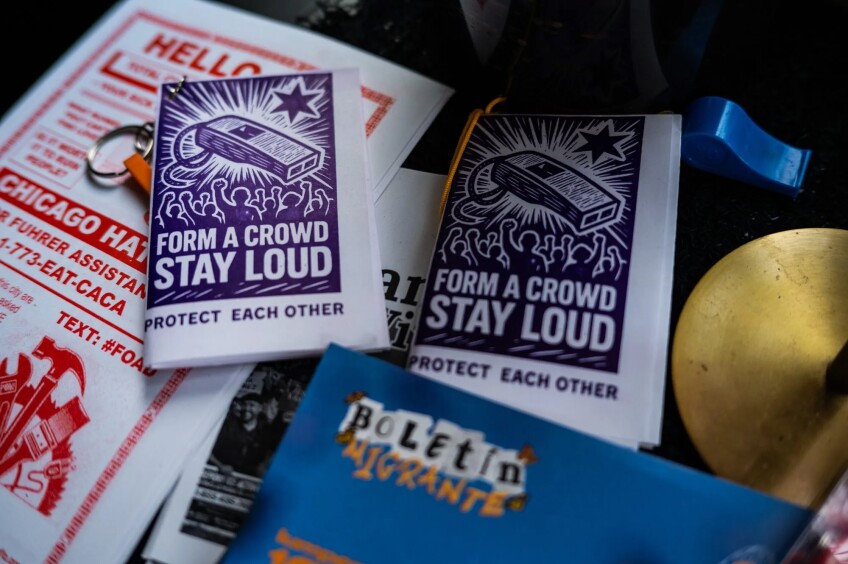
After the initial success, Zaragoza and dozens of volunteers distributed more than 120,000 whistles through dozens of Whistlemania events, with another 25 events planned in the coming weeks.
Neighbors and officials from Chicago’s suburbs, which federal agents have also heavily targeted, have also adopted the tactic, Zaragoza said.
Whistlemania is being adopted in St. Louis, Minneapolis, Denver and Atlanta, Zaragoza said.
Neighbors organize to support the most vulnerable
Street vendors, a backbone of many immigrant communities in Chicago and Los Angeles, have been frequent DHS targets. Some have chosen to stay home for protection, while others are forced to come out to sell food or goods, the primary source of income for their families, often facing drastically reduced sales.
The Street Vendors Association of Chicago followed the lead of Los Angeles groups that crowdfunded to financially support street vendors. The nonprofit launched a GoFundMe after many of its members reported staying home due to fear of being detained, said Maria Orozco, outreach organizer for the Street Vendors Association of Chicago.
Soon after launching, restaurants, bars, artists and local businesses across the city started organizing their own fundraising events or donating a part of their proceeds to the fund.
“It’s a community that has been directly hit because of the fear of being outside,” said Cadinho Bakery owner Maria Alejandra Rivera. Her Brighton-Park based shop raised $1,500 for the GoFundMe.
Customers were “very excited” to be able to support the initiative, Rivera said.
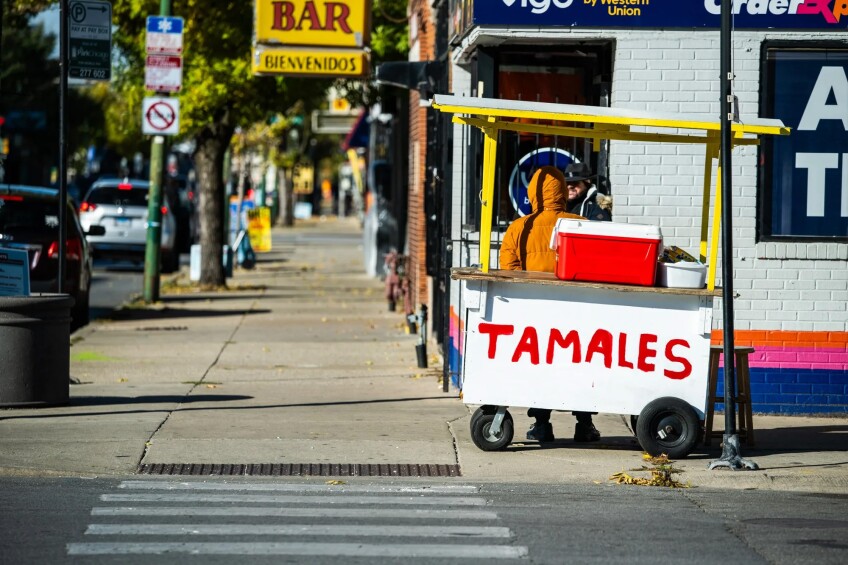
As of Nov. 3, the nonprofit had raised more than $270,000.
Cyclists have also come together to buy out street vendors in various Chicago communities, and neighbors have invited vendors to set up at their events.
Melissa McGlynn, coordinator of the food pantry and community closet at St. Genevieve Church, invited food truck vendor Lupita’s Quesadillas to a recent whistle-kit assembling event in Chicago’s Belmont Cragin neighborhood, where almost80% of residents identify as Latino or Hispanic.
Nearly all of the 65 neighbors who joined bought something from the vendor, who was forced to avoid its usual location after federal agents detained people in the area, McGlynn said.
“At this point, all of these events are helping. Little by little, we’re chipping away at all the negative effects of what’s going on,” McGlynn said. Street vendors are not the only ones afraid to leave their homes, neighbors said.

Adriana, a mother and lifelong Brighton Park neighbor — where almost 79% of residents are Latino or Hispanic — began organizing distributions of groceries and essential items for families staying at home.
In a social media post, she asked if like-minded individuals wanted to help make mandados, or run errands, and cover essential needs for undocumented families, said Adriana, who declined to share her last name.
Several people and local businesses quickly messaged her, and a Facebook group was formed.
Since then, the group has collected in-kind and financial donations for local families, distributing groceries and baby items to at least 50 families over three weeks, Adriana said. She spoke on a recent weekday while coordinating supplies at local daycare center La Casa Playroom.
To her side, piles of baby wipes, diapers, clothes and other items were piled up for distribution that week. La Casa owner Angie Maciel-Wright offered her business as a warehouse and collection center to support local families, she said.
“It’s just a stranger helping a stranger with a couple more strangers. And it feels really good to be part of this community,” Adriana said.
Where LA and Chicago go from here
In both cities, authorities have issued federal charges against people documenting agents for allegedly obstructing agents or impeding investigations, including charges against a Democratic congressional candidate. LA activist Matthew Hunter said the threat of federal charges, coupled with the Trump administration’s investigation of progressive nonprofit groups, is an effort to subdue mass resistance.
But decentralized resistance continues to grow and adapt.
“There has to be this constant dialogue and coalition building,” Hunter said, adding that sustained resistance in the months and years to come will require coordination across communities. “We’re leaning on social media to learn and share.”
Arghandiwal said the pandemic and deadly fires earlier this year in the wealthy Palisades neighborhood and more working-class Altadena spurred people to support their neighbors and forever altered the assumption that the government will be there to help in a crisis.
“The fires also woke a lot of people up, looking at how the Palisades were treated versus Altadena. We see when city officials are lying to us,” Arghandiwal said. “It prepared us to see that the government can be doing more.”
In Chicago, hundreds of neighbors who may not have been as active a few months ago or a year ago have mobilized after seeing “how vicious” the government has been to immigrants, particularly those who are Latino and have a darker skin tone, Zaragoza said.
Now, neighbors from all walks of life and almost every neighborhood and suburb are showing up for each other, he said.
That sentiment rings out in a chant commonly used by anti-ICE activists in both cities, Hunter said: “solo el pueblo, salva el pueblo,” or “only the people can save themselves.”
“Our city government hasn’t been there to protect us. We see law enforcement collaborating with ICE. They’ve basically capitulated to what’s happening,” Hunter said. “It’s really scary what the next year holds. There’s no savior coming.”

