
Subversive Light: How Judson Studios' Collaboration with Contemporary Artists Breaks from the Tradition of Stained Glass

Long before Judson Studios began fabricating radical contemporary art in glass, its founder was already operating outside convention. W.H. Judson, a plein air painter, arrived in the Arroyo Seco after years of artistic pursuit and became the first dean of USC's College of Fine Arts. His studio and its students were notably dominated by women artists at a time when female creative ambition was actively discouraged. From its earliest decades, Judson was an institution with a subversive streak that would quietly define the studio's identity across the next century.
That legacy finds its fullest expression in Judson's contemporary collaborations. Working in partnership with artists pushing well beyond ecclesiastical ornamentation, the studio has opened sustained dialogues on mortality, mental health, feminism, and cultural displacement. This subversive reengineering of an ancient medium carries ideas that might never have survived in any other form.

Commissioned in 1985 and realized in 1989, Jae Carmichael's Radiance Corridor at Mountain View Mausoleum in Altadena represents perhaps the studio's most formally surprising commission. Judson Studios director David Judson has described it as "perhaps the wildest stained glass ever created for a crypt." Designed by Carmichael and Walter Judson, the work is composed of select antique glass, handcut into an abstract arbor of prismatic shapes and flowers with a bold rose at the center of the far window. Reflected in the polished marble floors, the piece reverberates across the surface creating a psychedelic, tunnel-like effect.(1)
Carmichael was a descendant of the Giddings family, who founded Mountain View Cemetery, and her intervention in the mausoleum was a deliberate act of reclamation. Where mausoleum design typically aims for monumental solemnity, art in service of esteemed remembrance, Carmichael's rainbow shower of light brings levity and joy into a site of decay and mortality, upending mortuary convention entirely. Under her guidance the cemetery placed memory medallions linking to short documentary films on gravestones across the property. She also established a gallery within the mausoleum itself, actively expanding the site's artistic and educational role and replacing its anodyne memorial sensibility with something living.


Where Carmichael's subversion is contextual and spatial, Sarah Cain's collaboration with Judson operates on a register of pure painterly force. We Will Walk Right Up to the Sun, commissioned by the San Francisco Arts Commission for San Francisco International Airport, stretches over 150 feet, a monumental undertaking and Cain's first work in stained glass. The work showcases a stellar aptitude for how stained glass can be manipulated into ethereal rhythmic brushstrokes, harkening back to Judson's early students pushing boundaries and redefining who makes art and where it lives. Each panel establishes a distinctive play of light and color, prompting the viewer to journey in and beyond the frame through unique and disparate vantage points of texture and tonality.
Cain's piece is defiant and kinetic. In an airport, a space of transition, anticipation, and frenetic energy, Cain's expansive abstraction refuses the narrative obedience stained glass has historically been asked to perform. Against all these competing energies, her mural of light commands the viewer to pause, demanding a temporary escape from the mundane drain of airport passage. That insistence, carried across 150 feet of glass in one of the world's busiest transit hubs, is its own sustained act of formal rebellion.

On the interior public terrace of the Los Angeles County Department of Mental Health, Iranian-American artist Amir H. Fallah found an unlikely but precise home for his 2021 public artwork Portals, fabricated in collaboration with Judson Studios. Stained glass carries a heavily coded Western and Christian visual grammar, built across centuries to tell a particular civilization's story about itself. Fallah reclaims that grammar entirely. Depending on the viewer's vantage point in the garden, the windows shift, multifaceted in both their glass textures and light tonalities, and in their framing of movement between past, present, and future. The diasporic experience rendered not as arrival or exclusion but as threshold, perpetually open and perpetually in motion.(2)
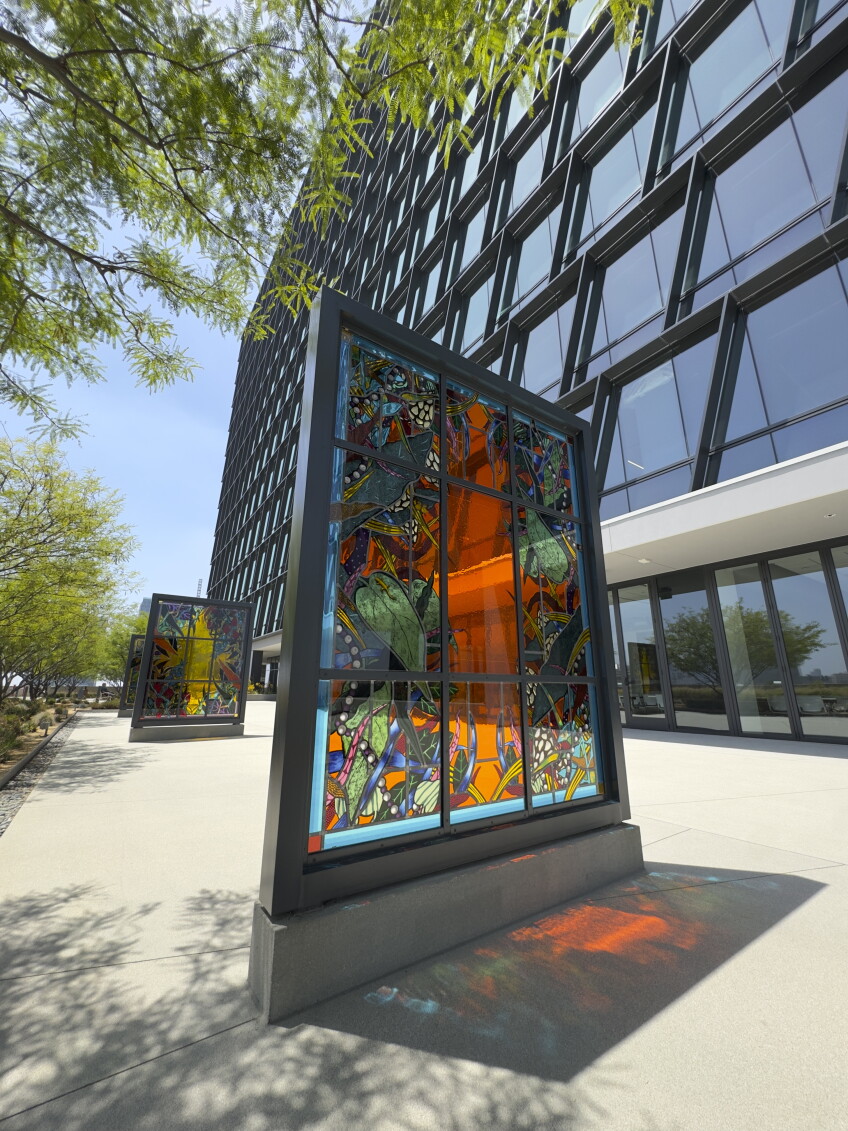
The setting of Portals is inseparable from its impact. The terrace is reserved for moments of escape, transition, and contemplation outside a bustling, practical city services building. Whether as employee or visitor, those who find themselves there are often navigating some of the most difficult passages of their lives. Fallah's art meets them in that moment, grounding the viewer in complexity and beauty precisely when it is needed most.
Stained glass has survived across centuries in part because institutions trust it. Carmichael, Cain, and Fallah, with Judson alongside each of them, understood that trust as an opening. The studio's most radical ongoing act may be its willingness to hand that inherited authority over to artists with something urgent to say, and a medium ideally suited to protect the message inside the form.
Endnotes
- David Judson and Steffie Nelson, Judson: Innovation in Stained Glass (Los Angeles: Angel City Press, 2020), 116.
- Judson and Nelson, Judson: Innovation in Stained Glass, 236.


