Back to Show
Lost LA

Venice

Season 3 Episode 5

From its origins as a themed seaside trolley resort to its international fame as a countercultural hub, Venice Beach has been in a state of perpetual renaissance, boasting a rich, multilayered history. This episode explores evolution of Abbot Kinney’s original Venice of America development, and how the commercial renaissance along Abbot Kinney Boulevard has impacted the historically African American neighborhood of Oakwood. We also look at the Beat poet community who called Venice home.

We start this episode featuring Edward Biberman’s mural of Abbot Kinney, founder of Venice of America, and a conversation with KCRW’s Frances Anderton about the Venice Canals. Historian Eric Dugdale shares Kinney’s entrepreneurial and inclusionary vision for venice, leading us to talk to heirs of Arthur Reese and Irvin Tabor, who held important roles in early Venice from within the African American community. We talk to Beyond Baroque founder George Drury Smith about what led to the 1930s Venice West Beat scene and discuss the works of photographer Charles Brittin and Beat poet Lawrence Lipton.

Support Provided By
Season
Historic Filipinotown
26:39
How Filipino Americans in Southern California are making their heritage more visible.
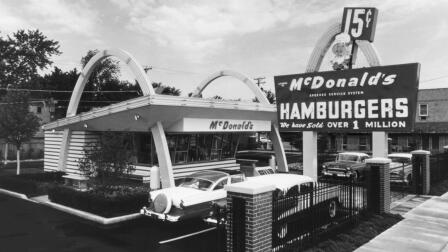
Fast Food and Car Culture
26:47
Iconic fast-food chains from McDonald’s to Taco Bell were born in SoCal.
From Little Tokyo to Crenshaw
26:37
After internment camps, Japanese Americans made L.A.'s Crenshaw neighborhood their home.
Prehistoric Landscapes
26:46
Dig deep into Southern California’s past to reveal lessons for our climate-changed future.
Winemaking
26:41
Explore a forgotten age when winemaking was Southern California’s principal industry.
Who Killed the Red Car?
26:46
Why did Los Angeles dismantle one of the greatest rail transit systems in the nation?
Shindana Dolls | Still from "Lost LA" S4 E6: Shindana Toy Company
26:40
Explore the lasting impact of the Shindana Toy Company, created out of the need for community empowerment following the 1965 Watts uprising, whose ethnically correct black dolls forever changed the American doll industry.
Mount Wilson Observatory | Image from "Lost LA" S4 E5: Discovering the Universe
24:52
As recently as a century ago, scientists doubted whether the universe extended beyond our own Milky Way — until astronomer Edwin Hubble, working with the world’s most powerful telescope discovered just how vast the universe is.
Paul Revere Williams opposite a man explaining a project | Courtesy of J. Paul Getty Trust. Getty Research Institute, Los Angeles
26:17
Although best known for designing the homes of celebrities like Lucille Ball and Frank Sinatra, the pioneering African-American architect Paul Revere Williams also contributed to some of the city’ s most recognizable civic structures.
Men and women toasting farewell to the 18th Amendment during Prohibition | Los Angeles Examiner Photographs Collection,University of Southern California Libraries
26:40
Prohibition may have outlawed liquor, but that didn’t mean the booze stopped flowing. Explore the myths of subterranean Los Angeles, crawl through prohibition-era tunnels, and visit some of the city’s oldest speakeasies.
A Monument in the Cemetery at Manzanar Relocation Center | Ansel Adams, Courtesy of the Library of Congress Prints and Photographs Division
26:40
During World War II, three renowned photographers captured scenes from the Japanese incarceration: outsiders Dorothea Lange and Ansel Adams and incarceree Tōyō Miyatake who boldly smuggled in a camera lens to document life from within the camp.
Young men walking with a view of Griffith Observatory | Courtesy of the California Historical Society Collection at the University of Southern California Library
26:48
Griffith Park is one of the largest municipal parks in the United States. Its founder, Griffith J. Griffith, donated the land to the city as a public recreation ground for all the people — an ideal that has been challenged over the years.
Active loading indicator