
Stones, Symbols and Mid-Century Vision: The Scottish Rite Masonic Temple

This program is supported by the City of Los Angeles Department of Cultural Affairs.
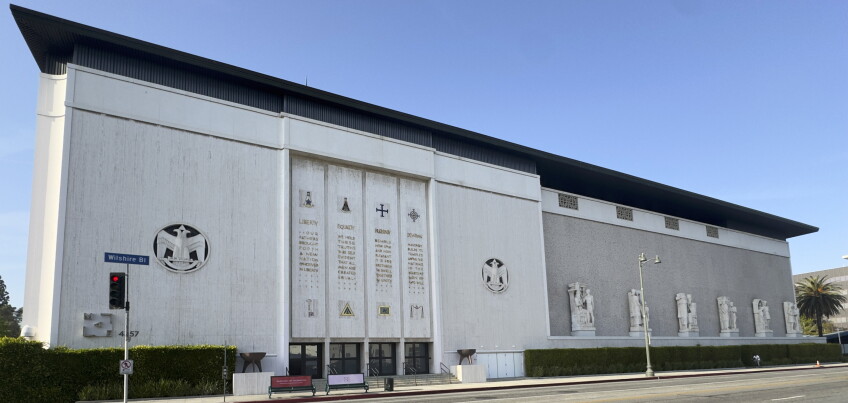
Driving Wilshire Boulevard one passes through a schism of Los Angeles identity, through cultural enclaves and remnants of a once glitzy Miracle Mile, and Museum Row en route to the glistening Pacific. At 4357 Wilshire stands the former Scottish Rite Masonic Temple, completed in 1961, a mysterious and foreboding structure that presents streetside like a judicial or governmental landmark. Clad in gleaming Italian travertine, adorned with bronze cauldrons, towering statuary, and intricate mosaics, it is perhaps one of the sleeper contributions to Los Angeles art and architecture that I would dare to say few know the layered history of. Millard Sheets and this massive undertaking deserves a long overdue reappraisal.
There are few artists who can hold the title of known and unknown more than Los Angeles' own Millard Sheets (1907-1989). Hiding in plain sight all across the city are the iconic and resplendent adornments of a watercolorist, mosaicist, and architectural designer whose ability to blend art, design, and architecture forever changed the city's built landscape. Those unfamiliar with his work need only stop by a local Chase Bank, formerly a Home Savings and Loan, to encounter his luminescent mosaic murals. Between 1954 and 1975 he designed forty such branch buildings across Southern California, a comforting mix of grandiosity and folksiness clad in travertine and alive with sculpture, stained glass, and custom furniture.(1)

Sheets called himself an "architectural designer" rather than an architect, and his buildings were consequently overlooked by an establishment that privileged credentials over creativity. What he practiced was total design: painting, mosaic, sculpture, and architecture, a full sensory experience. This put him in dialogue with mid-century design's biggest questions about how buildings could embody community and fuse function with beauty. Where the International Style stripped ornament away, Sheets insisted decoration was not excess but meaning. As critic Alan Hess observed, Sheets "brought the ancient human impulse to decorate living spaces with color, image, and gold into the twentieth century... a truly original concept that could not be easily identified by historians, and so was neglected."(2) The Scottish Rite commission was made for him.
Post-war Los Angeles was a city of tremendous building ambition. Wilshire Boulevard was transforming rapidly and the Scottish Rite Masons, whose membership was booming, did not want a revival-style cathedral in the mold of earlier fraternal architecture. They wanted a building that felt of its moment while carrying the weight of centuries of symbolic tradition.(3) Sheets answered with a structure unmistakably mid-century in its massing and restraint, yet richly pre-modern in its decorative conviction.
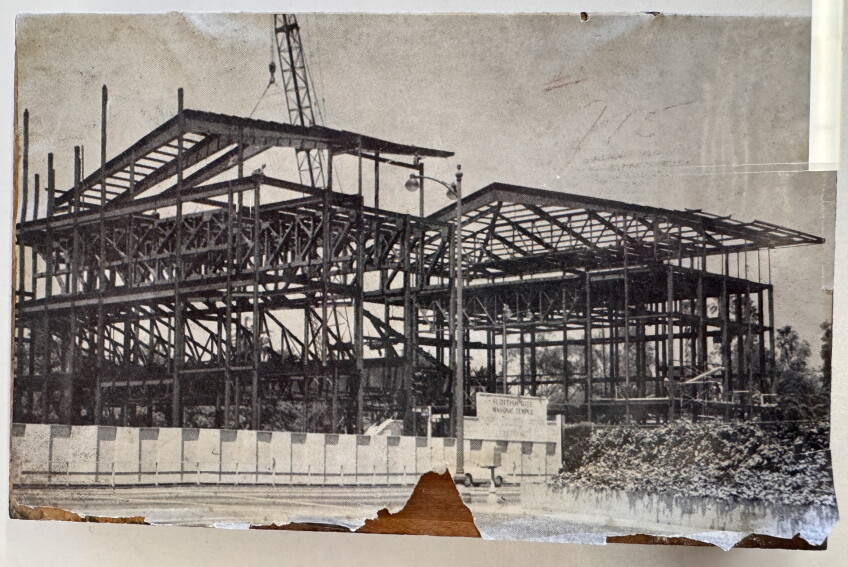
The four-story steel-framed building, nearly 100,000 square feet, is clad in Italian travertine that Sheets personally selected from quarries near Rome, finished with a low-pitched red tile hipped roof whose generous overhang nods to Frank Lloyd Wright's Prairie School filtered through a California lens.(4) The clean rectangular volumes and precise geometric organization speak the language of mid-century modernism. But Sheets refused to let that language be the last word.
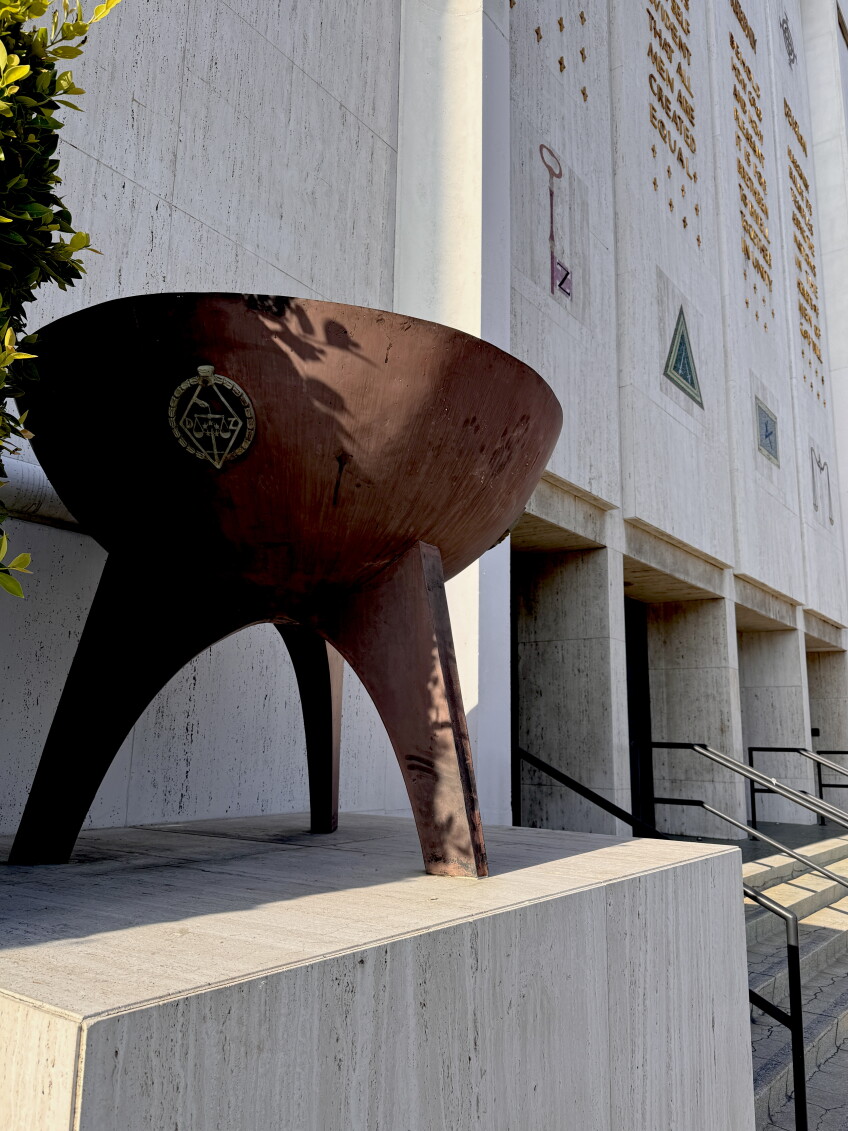
The exterior is almost windowless, a fortress, a deliberate nod to Masonic tradition since Lodge ceremonies are conducted in private. This gives the building its stately and ominous tone, that push and pull of revelation and concealment that defines the Masons themselves. The south facade entrance is flanked by bronze cauldrons atop travertine podiums, above which stone panels carry mosaics of Masonic symbols interspersed with Biblical inscriptions in raised brass lettering: Liberty, Equality, Fraternity, and Devotion on the south, Faith, Hope, and Charity on the west.(6) These are not decorative afterthoughts. They are the building's argument, legible from a moving car.

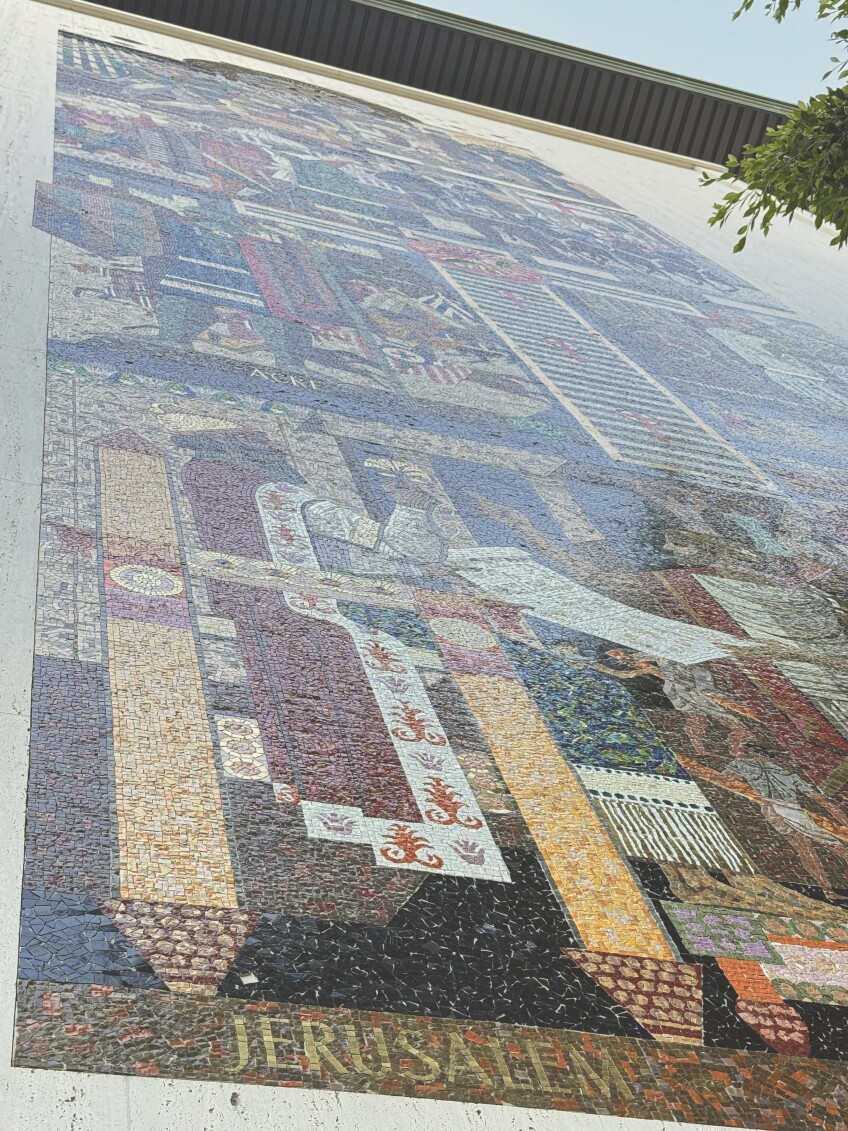
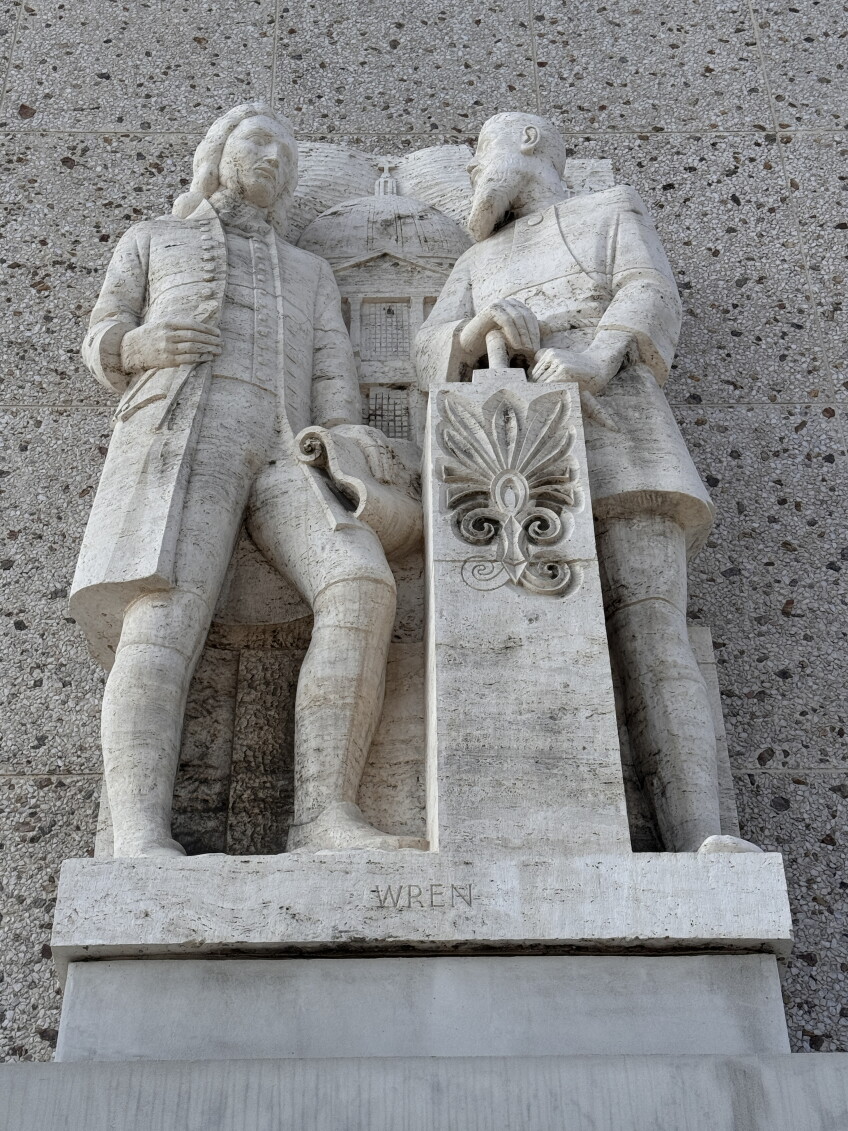
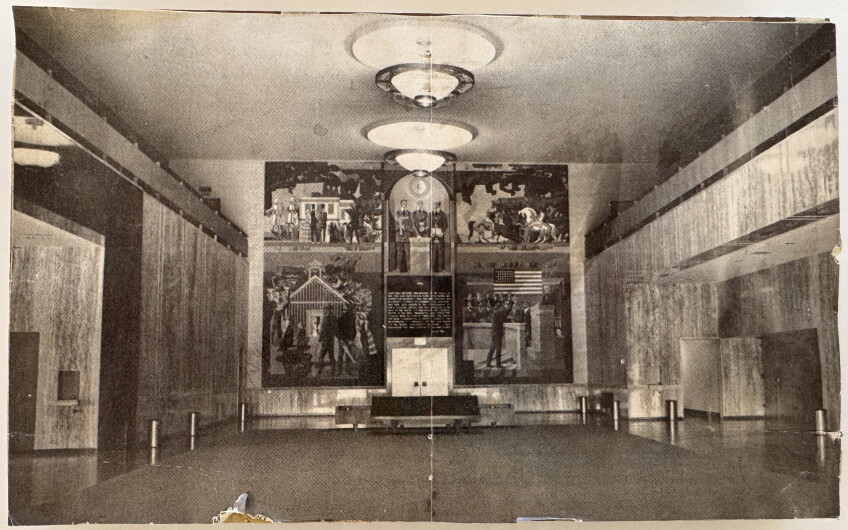
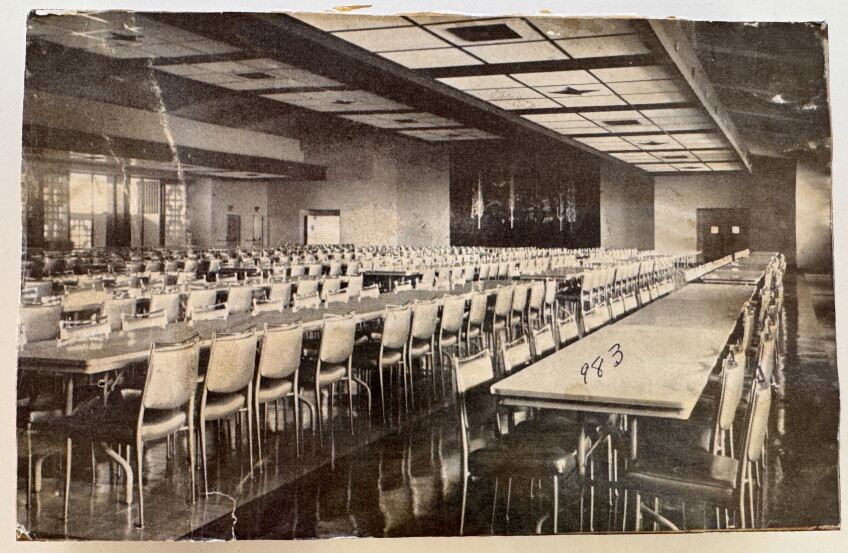
The eastern facade is an ambitious, monumental multi-story mosaic spanning from King Solomon's Jerusalem to twentieth-century California, conceived in the tradition of Gothic religious art that imparted meaning to those who could not read.(6) Eight travertine figures designed by Albert Stewart and carved in Rome represent the great builders of civilization from ancient Egypt through Christopher Wren, George Washington, and Albert Pike.(7) Inside, a 1,800-seat auditorium housed the Rite's elaborate theatrical degree ceremonies, supported by a dining room seating 900, three Lodge Rooms, and a library with one of Sheets' favorite murals, what he called a moody representation of ancient trees. Over twenty artists and craftspeople contributed, working under Sheets' direction as what he called the "executive artist."(8) He summed it up simply: "It's a city, a tremendous thing."⁹
When the Temple opened in November 1961, the Sovereign Grand Commander called it "the most beautiful Masonic Temple in the entire world, outside of the Supreme Council Temple in Washington, D.C."(10) The Los Angeles Times marveled it did not seem out of place beside the Byzantine domes of Wilshire Methodist Church or the Renaissance arches of the Ebell Club: remarkable for a mid-century building, to feel both new and rooted at the same time.
As Scottish Rite membership declined nationally, from a peak of 659,468 in 1980 to roughly 223,000 by 2010,(12) the Los Angeles Scottish Rite relocated to Santa Monica in 1994, leaving the Temple vacant for nearly twenty years. In 2013 Maurice and Paul Marciano purchased and renovated it into the Marciano Art Foundation, opened in 2017. The interior was largely gutted but the exterior survives almost entirely intact.
Mid-century Los Angeles traded permanence for spectacle and the city has been losing pieces of itself ever since. The Scottish Rite Temple stands against that tide, a reminder that the era's ambition reached beyond lightness and glass. In Sheets' hands the building claims something rarer, heft, longevity, and the quiet insistence that stone absorbs human meaning long after the city around it has moved on.
The Scottish Rite Masonic Temple on Wilshire Boulevard is hiding in plain sight, and has been for over sixty years. Millard Sheets made a total work of art at urban scale, enmeshed with meaning, beauty, and an unwavering belief that architecture and art should work as one. It is one of mid-century Los Angeles' boldest visions. It is time to look again.
Endnotes
- Laura Jane MacDonald, "The Iconic Millard Sheets Designed Scottish Rite Masonic Temple of Los Angeles, California: Reuse of a Mid-Century Modern Fraternal Building" (Master's thesis, University of Southern California, 2017), 13-14.
- Alan Hess, Forgotten Modern: California Houses 1940-1970 (Salt Lake City: Gibbs Smith, 2007), 257-258.
- MacDonald, 101-104.
- MacDonald, 137-138.
- MacDonald, 116-120.
- Oral History Program, University of California Los Angeles, Los Angeles Art Community: Group Portrait: Millard Sheets, interviewed by George M. Goodwin (Los Angeles: Regents of the University of California, 1977), 490-491.
- MacDonald, 131-132; Los Angeles Scottish Rite Bulletin XLIII, no. 4 (1960): 40-41.
- Janice Lovoos and Edmund F. Penney, Millard Sheets: One-Man Renaissance (Flagstaff: Northland Press, 1984), 66; Tony Sheets, ed., A Tapestry of Life: The World of Millard Sheets (Pomona: Fineline Creative Services, 2007), 72.
- Oral History Program, UCLA, 494-495.
- "Scottish Rite Masonic Temple Special Ceremony Finishes Dedication," Los Angeles Herald-Express, November 11, 1961, A4.
- William L. Fox, Lodge of the Double-Headed Eagle: Two Centuries of Scottish Rite Freemasonry in America's Southern Jurisdiction (University of Arkansas Press, 1997), 337-338; S. Brent Morris, personal correspondence cited in MacDonald, 74.